Nikolas Dimitroulakis
API Client Security for Enterprises: The Vendor Risk Nobody Reviewed
Somewhere in your company, right now, a developer is pasting a production-adjacent auth token into an API tool that nobody in security ever reviewed. Multiply that by every developer you employ. That's the actual surface we're talking about.
Enterprise API tooling privacy means controlling what the tools your developers use to design, test, and document APIs store, transmit, and share with third parties: auth tokens, internal endpoint URLs, request payloads with real customer data, and background usage telemetry. Most companies have a policy for cloud storage, a policy for messaging tools, and no policy at all for the tool that touches every API before anything ships.
We wrote recently about what popular API clients send home from an individual developer's machine. This post is about what happens when you scale that from one laptop to an engineering org, because the risks don't just multiply. They change category. What's a privacy preference for one developer is a compliance question for a company.
What enterprises actually ask of developer tooling
Tooling decisions in an enterprise aren't made by one person, and each person in the room is worried about something different. It's worth naming those worries plainly, because they explain why a tool that developers love can still fail a review, and why a tool that passes review can still die in the org.
The CISO's questions are about data paths. What leaves the company's machines, where does it go, who are the sub-processors, and can we prove all of that to an auditor. Credential sprawl sits high on this list: every tool that stores tokens is another place credentials can leak from, and every vendor cloud holding request payloads is another breach headline waiting to have your name in it. Software supply chain comes right behind: what does this thing actually do on the network, and can we verify it or only trust it.
The engineering leader's questions are about fit and exit. Does it work the way the team already works, with Git, code review, and CI. Does it keep working offline, on restricted networks, at a client site. And if we walk away in two years, do we keep our work, or is three years of API collections held in a format only the vendor can read.
Procurement and legal ask about the contract. Is there a DPA, is the sub-processor list stable, is pricing predictable or does it grow a new per-seat meter every renewal.
A tool gets adopted when it answers all three at once. Most API tooling today answers the engineering question well and hands the CISO a homework assignment.
API tooling is shadow IT, and shadow IT ships one download at a time
Nobody files a procurement request to install an API client. A developer downloads one in their first week because the README says "test it with Postman." A second developer joins the collection to stay in sync. Then the team standardizes on it. Then it's infrastructure.
At no point in that sequence did anyone from security, legal, or IT look at the tool. It crossed from personal utility to company infrastructure without crossing anyone's desk. And what it holds is exactly what the CISO's questions were about:
- Credentials. Bearer tokens, API keys, OAuth client secrets, sometimes for staging, sometimes not.
- Topology. Internal hostnames, staging URLs, the shape of endpoints that haven't shipped yet. A synced collection is a partial map of your infrastructure.
- Data. Request and response bodies. If your developers debug against realistic payloads, that's customer data, and under GDPR it doesn't matter that it was "just for testing."
- Behavior. Telemetry about who uses what, when, and how, flowing to the vendor's analytics stack.
None of this is hypothetical. In a mid-2025 traffic capture, opening one popular client and sending a single request produced ten outbound calls to external servers, including analytics events and a 112 KB feature-flag payload. That was one developer, one request. An enterprise runs that pattern thousands of times a day.
The compliance surface you inherit with a cloud-first tool
When collections sync to a vendor's cloud by default, your company inherits obligations it may not know it signed up for.
GDPR and data residency. If request bodies contain personal data and they sync to a vendor's servers, that vendor is processing personal data on your behalf. You need a DPA with them. You need to know where the servers are. If your contracts promise EU data residency and your developers' collections sync to infrastructure you never verified, that promise has a hole in it.
The sub-processor chain. A DPA with the vendor is only the first hop. Vendors have their own sub-processors, and that list changes. Postman's published sub-processor notices added a major LLM provider in mid-2026, processing data created through the service. If your vendor review happened in 2024, your data's actual destination list has changed since.
SOC 2 and ISO 27001 vendor reviews. Auditors ask which third parties handle company data. An unmanaged API tool with cloud sync is exactly the kind of finding that turns a clean audit into a remediation plan. The awkward part isn't that the tool is risky. It's that nobody can answer basic questions about it: what data leaves, where it goes, who can access it, how it's deleted when someone leaves.
Offboarding. When a developer leaves, you revoke their SSO, their email, their repo access. Their personal account on an API platform, with your collections and environments synced to it? That one's easy to miss, because it was never in your identity system to begin with.
Availability as a dependency. During a large cloud outage in late 2025, one major client's desktop app stopped working entirely. For an individual that's an annoyance. For a company, an external vendor's uptime just became a dependency of your internal development workflow, without anyone deciding that on purpose.
How the popular tools answer these questions
We ran the traffic-capture comparison of the individual clients in the previous post. Here's the same field viewed through the enterprise questions above.
| Tool | Where data lives by default | Account surface | Telemetry control | Format portability | AI data path |
|---|---|---|---|---|---|
| Voiden | Local .void files in your repo | No account exists | None collected | Plain Markdown, any editor | You choose the agent and provider |
| Postman | Vendor cloud; Git/offline YAML mode added in 2026 | Required to collaborate | On, no opt-out | Export only; gRPC and WebSocket requests don't export | Vendor-selected LLM provider, added as sub-processor mid-2026 |
| Insomnia | Cloud-encouraged; limited local scratchpad | Heavily encouraged; Git sync is paid | Off only when logged out | Proprietary local format | Vendor's AI-native platform |
| Bruno | Local .bru files on disk | No account needed | On by default, can be disabled | Plain text, custom markup needs Bruno | None built in |
A few enterprise-specific notes the table can't carry.
Postman is the one most likely to already be in your org at scale, which makes it the most urgent review. The 2026 rebuild added a genuine concession to the local-first critique, a Git-native offline mode with a diffable YAML format, and that's worth acknowledging. But the default still points at the cloud, the telemetry still has no off switch, and the free tier went single-user in March 2026, so the moment two developers collaborate, procurement is involved. For a CISO, the mid-2026 sub-processor addition of an LLM provider is the line item to read twice.
Insomnia, owned by Kong, has the detail that says the most in an enterprise review: telemetry can only be disabled when logged out, and the logged-in stream carries a hash of the user id. An off switch that disappears when your developers sign in is an answer to the "what is the account for" question. Git sync behind a paid plan also means the one workflow that would keep your data in your own repo is the one that's metered.
Bruno is the closest neighbor and deserves the credit we gave it before: local-first, no account, and after a year of feedback it shipped a telemetry toggle. For an enterprise, the two open items are that telemetry is still on by default, so it needs to be part of your rollout configuration rather than something you get for free, and that the .bru format needs Bruno to read, which matters on the day an auditor, or a successor tool, needs your collections without it. Its move from a one-time license to subscription tiers in 2026 is also worth noting for the procurement column.
The pattern from the individual review holds at company scale, just with higher stakes: the tools differ less in features than in how much of your data their architecture assumes it's entitled to.
The agentic era makes all of this sharper, not softer
The big API platforms spent the past year rebuilding themselves around AI agents. Postman's 2026 rebuild centers on an Agent Mode; Insomnia now positions itself as an AI-native collaboration platform. Whatever you think of the features, they share one architectural fact: an AI feature needs somewhere to send your requests, and in a cloud-first product, that somewhere is the vendor's chosen model provider. That's how an LLM company quietly joins your sub-processor list.
For a CISO, agents raise the stakes on every question above. An agent that tests APIs holds credentials and sees payloads, exactly like a developer does, except it runs more often, at machine speed, and its data path is whatever the platform wired in. "Which humans can access this data" becomes "which humans, which agents, and which model providers behind those agents."
The reasonable response isn't to ban agents from API work. It's to insist on the same principle that applies to everything else in this post: you choose the data path. An agent working against plain files on your disk, running in your environment, with the model provider your company already vetted, is a governable setup. An agent baked into a vendor's cloud, with the vendor's model choices and the vendor's data handling, is a second, opaque data plane you now have to review on top of the first one.
Agent-readable tooling and privacy-first tooling are not in tension. Files in a repo are the most agent-friendly interface there is.
What a local-first, Git-native architecture buys an enterprise
Here's the part that surprises people who approach this as a compliance chore: the privacy-first architecture isn't just lower risk. It's less work. Almost every control an enterprise would need to build around a cloud-first tool already exists in your Git infrastructure, because you built it for your code.
Vendor risk assessment shrinks toward zero. A vendor you send nothing to is a vendor you don't have to assess. No telemetry and no sync means no DPA to negotiate, no sub-processor list to monitor, no data residency question to answer. The review becomes a code inspection, not a contract negotiation.
Access control is your repo permissions. If API work lives as files in the repo next to the code, the people who can see it are the people who can see the repo. You already manage that. No second permission system to configure, drift, and audit.
The audit trail is Git history. Who changed the auth block, when, and in which pull request. That's not a premium logging feature. It's git log, the same evidence trail auditors already accept for your source code.
Offboarding is already solved. Revoke repo access, done. No orphaned vendor accounts.
It works where your constraints are hardest. Air-gapped environments, regulated networks, client sites with restrictive egress policies. A tool that assumes no network access for its own operation keeps working in all of them.
Cost doesn't scale with headcount. The cloud platforms have been moving the other way. Postman's free tier went single-user in March 2026, putting a five-person team at roughly $912 per year, and Bruno retired its one-time license in favor of subscription tiers in 2026. When collaboration happens through Git, there's no per-seat meter running on it.
If you want to see what the Git-native workflow looks like in practice, there's a short video on it: https://youtu.be/fekca2eWLDY.
The vendor assessment checklist for API tooling
Whether or not you change tools, these are the questions worth putting in your actual vendor review. Each one has a checkable answer.
- Where does collection data live by default? Local disk, vendor cloud, or "local until you log in." The default is what your developers will actually run.
- Can telemetry be disabled, and does the setting survive login? A tool whose off switch only works when signed out has told you what the account is for.
- What's in the sub-processor list, and when did it last change? Check the vendor's published notices, not the sales deck. Look specifically for analytics providers and LLM providers added recently.
- Is the storage format readable without the vendor's software? Plain text and Markdown can be audited, diffed, and retained on your terms. A proprietary format means your data's readability depends on the vendor's continued existence and goodwill.
- Can it run fully offline, indefinitely? Not "offline mode for a flight." Fully functional with no network access, forever.
- Where do the AI features send data? If the product has an agent or assistant built in, which model provider receives your requests, and can you turn the whole path off or substitute your own vetted setup.
- Is the source code available for inspection? An open-source license means your security team can verify network behavior by reading the code instead of trusting a questionnaire answer.
- What happens to a departing employee's data? If the answer involves contacting vendor support, the architecture has already failed this question.
- Intercept it once. Point the tool at a proxy, send one request, read what else goes out. Thirty minutes of a security engineer's time, and the results tend to end the debate.
Where Voiden fits
First, the category, because it matters for what an enterprise is actually evaluating. Voiden isn't a simple API client with a request form and a send button. It's an API IDE: the place where teams design, test, and document APIs as one workflow. Requests, assertions, docs, environments, and reusable auth blocks live together in plain .void Markdown files. Pre and post-request scripts run in JavaScript, Python, or shell on your real machine, not in a constrained sandbox. The Stitch runner batch-executes whole sets of files, the CLI runs the same files in CI/CD, and cast publishes documentation from the same source. REST, GraphQL, gRPC, and WebSockets are each installable plugins, and existing Postman, Insomnia, and OpenAPI collections import directly. This is the scope of tool a platform team standardizes on, which is exactly why it deserves the scrutiny this post describes.
It's built to pass that scrutiny by architecture, not by policy. No telemetry to configure, because none is collected. No account system, so no orphaned accounts to offboard and no login gating features. Everything lives in your own Git repo, so your existing permissions, review process, and audit trail cover your API work the same way they cover your code. The format is readable in any text editor, so retention and audits don't depend on us. And it's open source under Apache 2.0, so a security review can be a code review: https://github.com/VoidenHQ/voiden.
For the agentic side, Voiden ships skills for Claude and Codex agents and an agent-friendly CLI. Enable the AI Skill and Voiden generates a local skill file that teaches your assistant the .void format, so the agent you already vetted writes and runs API tests as plain files in your repo, through the review process you already have. Voiden doesn't add its own model provider, its own AI cloud, or a second data plane. The agent setup, and its data path, stays your choice.
There's also nothing behind a paywall. No enterprise edition, no per-seat tier, no feature that appears when procurement signs. Voiden is funded by ApyHub's marketplace revenue and built as long-term open infrastructure, so the version your developers download is the whole product.
One tradeoff, stated plainly: Voiden has no cloud dashboard and no vendor-hosted admin console, because collaboration is Git, with the branches, reviews, and permissions you already run. Teams that specifically want a web console for watching their own developers work won't find one. Security teams tend to read that as the feature: there's no second data plane to govern, because there's no second data plane.
That architecture is already trusted where the compliance bar is highest. Voiden is used inside one of the largest banks in central Europe, the kind of environment where every tool on a developer's machine gets the full review this post describes.
FAQ
Do API clients send data to third parties? Many do. Cloud-first tools sync collections, environments, and history to vendor servers by default, and most popular clients transmit usage telemetry to third-party analytics services. AI features add model providers to that list. The specifics vary by tool and by whether you're logged in, which is why intercepting your own tool's traffic once is worth the time.
Can API tooling run in air-gapped or restricted environments? Only if it's built offline-first. Tools that require an account or phone home for feature flags degrade or stop working without network access. A local-first API IDE that stores everything as files on disk, like Voiden, runs the same with or without a connection.
What should a vendor risk assessment for API tooling cover? Default data storage location, telemetry behavior and whether it can be disabled, the vendor's sub-processor list, where AI features send data, format portability, offline capability, source code availability, and employee offboarding. The checklist above walks through each with the checkable version of the question.
How do AI agents change API tooling security? Agents hold credentials and see payloads the way developers do, but they run more often and their data path is set by the platform they're wired into. The governance question becomes which model providers sit behind the tools. A setup where agents work against plain files in your repo, using a model provider your company chose, keeps that path under your control.
Wrap-up
The question for an enterprise isn't whether an API tool is convenient. It's how much of your company's data the tool is allowed to hold, and how much of it leaves, before anyone with a security title has looked at it. Cloud-first platforms answer that with a DPA, a sub-processor list, and a subscription that now includes an AI provider. A local-first, Git-native API IDE answers it with your own repo.
One of those answers gets shorter every year. The other one keeps growing new attachments.
Voiden is open source under Apache 2.0. Download it at https://voiden.md/download, or read the code at https://github.com/VoidenHQ/voiden if your security team wants to check our claims the proper way.
Related Posts
Phurpa Tsering
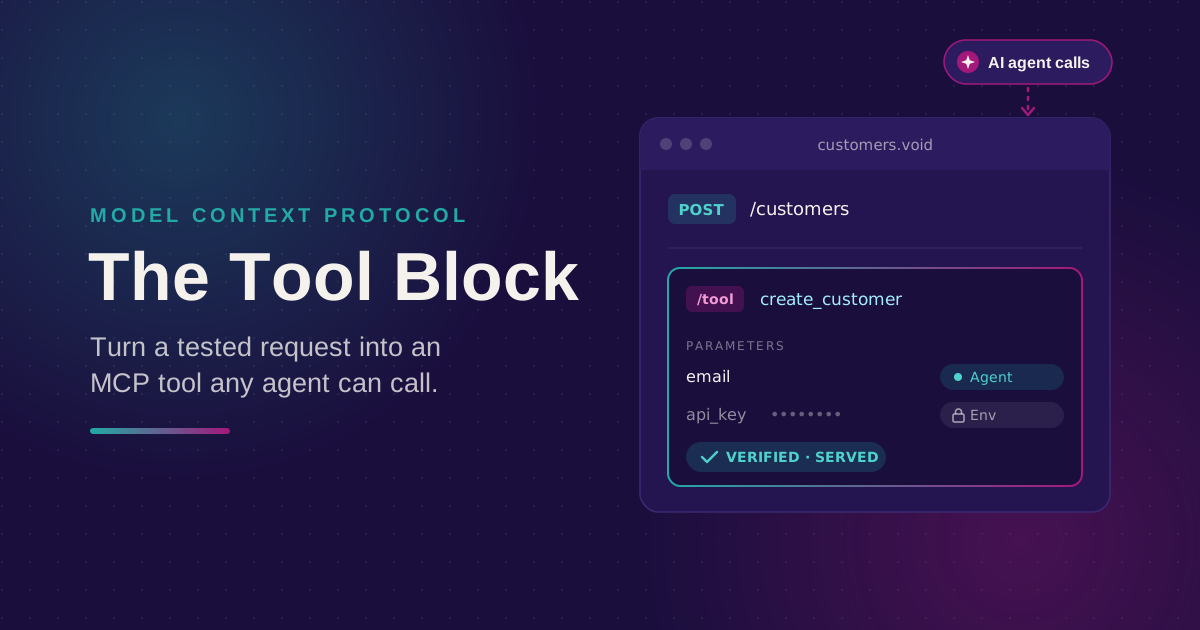
Turn Your Tested API Requests Into Agent-Callable MCP Tools
Turn a request you've already tested into an MCP tool that agents can call, then publish it with @voiden/mcp. Use stdio for local use, or --http/--tunnel for a server you can host.
Phurpa Tsering
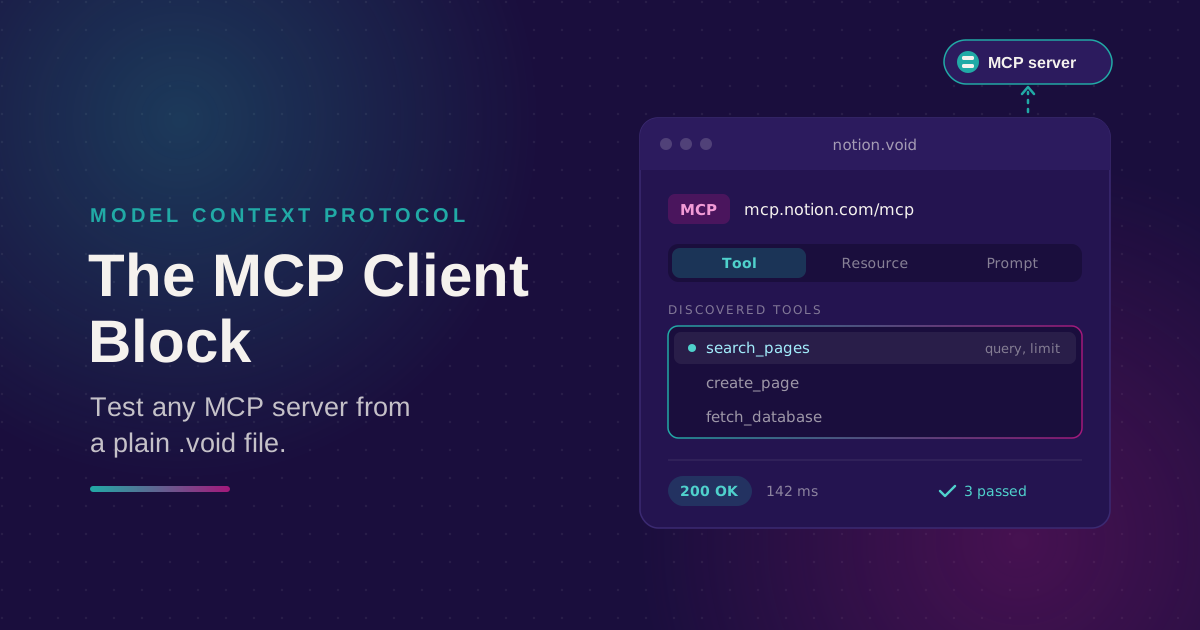
Bring Any MCP Server Into Your API Testing Workflow
Connect to any Streamable HTTP MCP server, browse its tools, resources, and prompts, and call one. Check the response with the same auth and assertion blocks you use for REST, all from a plain .void file.
Phurpa Tsering
Give Your Coding Agent Real Access to Your API Requests
One status-bar button (or one CLI command) registers your project with Claude Code or Codex over MCP, giving your coding agent the same six tools Voiden uses to list, run, and manage requests.